provoking thoughts about the presence of our past

Thursday, October 15, 2015

Drawing a Line in the Sand: The Fight Over 105 Keefer

Controversial Chinatown proposal rejigged

Wednesday, October 14, 2015
By John Mackie, Vancouver Sun
http://www.vancouversun.com/business/story.html?id=11438334&__lsa=1a03-5620

 
Model for a 13-storey building at 105 Keefer Street (at Columbia) in Vancouver’s Chinatown.
 
 
VANCOUVER -- A proposal for a 12-storey, 137-unit condo on an empty lot at Columbia and Keefer in Chinatown stirred up a storm of criticism last fall.
Chinatown activists felt the building looked more like Yaletown than Chinatown, and didn’t reflect the vision plan the Chinatown community had put together with the city.
So the developer went back to the drawing board to address their concerns. Last week, the Beedie Group unveiled a new 13-storey, 127-condo proposal at 105 Keefer that includes 25 social housing units for Chinese seniors.
“The previous proposal had no inclusion of seniors or non-market housing,” said Houtan Rafii of the Beedie Group. “We now have 20 per cent of the project, 25 units, of seniors housing.”
The building design has also been changed.
“The building look and feel, the materiality, the detailing is much more sensitive to Chinatown,” said Rafii.
“The massing, the size and the bulk of the building, its sight lines and its relationship to Sun Yat-Sen Garden (have been adjusted). The retail’s been rejigged. It’s all 25-foot increments, and it’s conducive to what’s found elsewhere in Chinatown.”
Still, the changes weren’t enough for University of B.C. history professor Henry Yu.
“I have nothing against the Beedie Group wanting to build a building that is condos, it’s just not here,” said Yu.
“This is an anchor site, it’s crucial for Chinatown as a heritage conservation area. It’s the heart of Chinatown. It’s next to the Sun Yat-Sen Garden, to the Chinese Cultural Centre, to the historic buildings on Pender, to the memorial square (at Columbia and Keefer).”
Yu would like to see the city take over the site, either by purchasing it or doing a land swap.
“Twenty-five seniors housing units I think is great, but it should be 250,” he said.
“If you want to rezone, there’s a high bar for rezoning in a historic area. This (proposal) is the same formula as a CAC (community amenity contribution) anywhere in the city for rezoning. So don’t do it.
“At UBC we did a study (that found) we need 3,000 Chinese seniors units over the next five years. Twenty-five isn’t going to get you there — 250 will get you farther. You’ll still have to do more, but that’s a better use (of the site).”
A city representative at an open house at the Chinese Cultural Centre Oct. 6 said there were no plans for the city to purchase the site.
The Beedie Group paid $16.2 million for the two parcels of land on the site in 2013. The site is 149 feet wide east to west, and 121 feet deep north to south. It used to house a garage, and will have to be decontaminated before anything can be built.
Beedie bought the site after the city rezoned parts of Chinatown, hoping to revitalize the long-moribund neighbourhood. Several developers quickly moved in, drawn by Chinatown’s cachet and proximity to downtown.
“It’s one of Vancouver’s most historic, revered neighbourhoods,” said Rafii. “It’s authentic, it has history, it has culture. It’s a great site.”
Architect Greg Borowski set up a panel at the Chinese Cultural Centre to show how the revised plan reflects the project’s “enhanced Chinatown character.”
“We’ve put part of our building adjacent to the (1909) Chinese Benevolent Society building, and compared items,” said Borowski.
“You can see (we have similar) recessed balconies, the 25-foot bay modules, the brick differentiation. You can see the pattern on the balcony guardrails, and the patterning on the window mullions behind.
“You can see the colour in the recesses of the balconies. You can see the parapets that extend above the principal parapet in front. The cornice line, you can see the two-storey expression at the ground floor with the retail. All of those things are directly informed by the Chinatown character.”
In the original design, the retail spaces on the main floor were long and had glass awnings. But Chinatown has historically been small shops on 25-foot storefronts, so the retail spaces have been changed to reflect this.
“We have fabric awnings. We do not have glass, and they’re retractable,” said Borowski.
“These fabric awnings go in and out, so it will also create an interest, because when someone opens their awning you’ll know they’re open. They’re all different colours, but then the colour palate is matched together so that it harmonizes.”
Yu just doesn’t think it harmonizes enough with the historic neighbourhood.
“You can do amazing things with that site,” he said. “It’s not being done with this.”
jmackie@vancouversun.com
===
© Copyright (c) The Vancouver Sun


The heritage battle for Chinatown

http://www.getintheknow.ca/news/article/201411/heritage-battle-chinatownoriginally published in the Vancouver Sun, Nov. 14, 2014

Historic Vancouver neighbourhood is being redeveloped, raising fears it will lose its character
The marketing line for the Keefer Block condo development in Chinatown is “Heritage Meets Modern.”
But just how much heritage will be left after a wave of modern developments washes over the historic district is a matter of debate.
A new proposal for the 700-block of Main Street would demolish the last three buildings from Hogan’s Alley, a once-notorious back lane that was the longtime home of Vancouver’s black community.
Another condo development at 231 Pender would replace a funky, Chinese-themed garage that is listed on Canada’s Register of Historic Places. Angelo Tosi’s family has owned their building at 624 Main since 1930. It may date back to 1895, and looks it — the fixtures and shelving are as old as the hills.
But Tosi is 82, and will probably sell when the price is right. He doesn’t expect his store to survive.
“It’ll be gobbled up by the monstrous buildings,” said Tosi. “And then they’ll take it all, and it’s finished. They won’t keep the heritage on the bottom, they’ll put down whatever they want.”
His fatalistic attitude reflects the changes in Chinatown, which is undergoing a development boom after zoning changes by the City of Vancouver.
The protected “historic” area of Chinatown is now Pender Street, while much of Main, Georgia and Keefer can now be redeveloped, with heights of up to 90 feet (nine storeys). A few sites can go even higher.
Two towers are going up at Keefer and Main — the nine-storey, 81-unit Keefer Block, and the 17-storey, 156-unit 188 Keefer. Up the street at 137 Keefer, a development permit application has just gone in for a new nine-storey “multi-family building.”
None of them has stirred up much controversy. But a recent public meeting about a 12-storey, 137-unit condo to be built on an empty lot at Keefer and Columbia got people riled up.
“There was a lot of angry people that night,” said Henry Yu, a UBC history professor who feels a “vision plan” the Chinatown community worked on with the city for several years is being ignored.
“The vision plan gets passed, (but it has) no teeth,” said Yu. “Actually (there is) no policy, it’s a wish list of ‘Oh, we’d like seniors housing, we’d like to do this, we’d like to do that.’
“Almost immediately, the two (highrise) buildings in the 600-, 700-block Main go up, and they’re just basically Yaletown condos. Not even Yaletown — Yaletown has more character.
“These are straight out of the glass tower (model), no (historic) character, obliterating everything in terms of tying it to the kind of streetscape of Chinatown. You’re going to split the historic two or three blocks of Chinatown with a Main Street corridor of these glass towers.”
Yu says Chinatown has historically been small buildings on 25-foot lots, which makes for a jumble of small stores that gives it a unique look and character. But the new developments are much wider, and just don’t look like Chinatown.
“The two 600-, 700-block buildings have a rain shield that’s an awning, a glass awning that runs the whole block,” said Yu. “That’s the design guideline for the city as a whole, but it was nothing to do with Chinatown, (which is) narrow frontages, changing awnings.
“We said that (to the city planners), we raised it and raised it, but the planners just shoved it down our throat.”

Friday, June 26, 2015

Blaming the Mainlander--Vancouver & Hong Kong: Foreign Investment Crisis?

One of the other groups of students in my History 482 class addressed the issue of all of the talk about Mainland Chinese being the cause of our high real estate prices. They did an incredible job of thinking through the thorny issues and placing what is going on in the city right now within a longer historical context of the real estate market and colonialism in Vancouver.

Their work was featured in the Vancouver Sun in a story by Joanne Lee-Young:

UBC students tackle housing affordability issues

Organizers of donthaveamilliondollars movement gathered Wednesday night to press the provincial government to collect data on how foreign investment is impacting housing affordability.

By Joanne Lee-Young, Vancouver Sun June 25, 2015

Jane Shi, an undergrad student at the University of B.C., was visiting Hong Kong last week, trying to take on “the question of who and why people are blaming mainland Chinese investors for the housing crisis in Vancouver and Hong Kong.” In past years, students taking a UBC summer history course on Chinese migration have compared heritage buildings or night markets in various Asian cities. This year, with debate on skyrocketing real estate prices sparking racial and generational rifts, two groups in the class chose topics that are newly binding Vancouver to cities such as Hong Kong and Singapore: housing affordability, what to do and who is at fault.

Shi and a few classmates are making last minute edits and in a few days will release a short film called “Blaming the Mainlander.” It’s their look at “what is ‘foreign,’ and how and why when we say ‘foreign’ right now, we mean (mainland) ‘Chinese,’” said their instructor, UBC professor Henry Yu. Shi said “visiting Hong Kong (for the first time) and learning more about its history … helped shape the conversation a lot better, as resentment against mainland Chinese in Hong Kong can’t be exclusively explained (by race),” said Shi. “So there’s nuance that gets lost in responses to the conversation on ‘blaming the mainlander’ in Vancouver.”

Another group interviewed students, academics and policy-makers in Hong Kong to make a video comparing affordable housing solutions there to ones in Vancouver. The housing affordability ratio (median housing price divided by median income) in Hong Kong is 17, the highest in the world, while Vancouver is now at 10.6, the second highest. The higher the ratio, the less affordable the housing. The students detailed that while three per cent of residents in Vancouver live in government-subsidized housing, the number in Hong Kong, at 48 per cent, is much higher. “It was a profound comparison to see how people perceive government-subsidized housing,” said student Adam Gold. “There is a stigma associated with it in Vancouver. In Hong Kong, it’s normalized and not just for low-income people.”

The students find themselves posting their findings as the Chinese government’s top representative in Vancouver made the unusual move of speaking candidly about who to blame and what might be done to handle the current real estate market. Consul-general Liu Fei told the Globe and Mail this week that it’s “wrong” for local residents to be pointing fingers at wealthy Chinese buyers for driving up housing prices. While Liu acknowledged there is demand for Vancouver real estate, she called for government officials in Canada to regulate buyers, sellers and developers with quotas for affordable housing and for luxury houses, “higher prices for overseas investors,” adding that Beijing itself has strict housing policies in mainland China.

To date, Vancouver mayor Gregor Robertson has asked B.C. Premier Christy Clark to bring in a speculation tax against those who buy and sell real estate to make a profit in a brief amount of time. The province has said it has no plans to do so, citing a reluctance to hurt the home equity of existing owners. On Wednesday, Eveline Xia, who created the Twitter hashtag #Don’tHave1million, was getting ready to address a second rally to bring attention to housing costs and the challenges for millennials in Vancouver. In a prepared speech, she asks: “Will it actually take someone like the Chinese envoy to Vancouver to suggest government action is needed, before our own politicians finally wake up?

© Copyright (c) Vancouver Sun


And the film (online at youtube.com/watch?v=WB2VcAKZ_jI)...

Blaming the Mainlander--Vancouver & Hong Kong: Foreign Investment Crisis


Description:

This film was created by students of Professor Henry Yu's History 482 class.

Filming locations include Shanghai, Vancouver and Hong Kong.

Created by: Amanda Chiu, Tyler Mark, Allison O'Neil, Jane Shi, Minnie Tsai and Ralph Tsang

Special thanks to Professor Henry Yu, our TAs Alyssa Leung and Joanna Yang, as well as all our interviewees.

Monday, June 22, 2015

Why should the youth living in Vancouver and Hong Kong care about afford...

Proud of the work that our students in History 482 did these past two months. This is one of the three films that were made. This group's work focused on housing affordability in Vancouver and Hong Kong and why it should be of special concern to youth. Many thanks to the research assistants Alyssa Leung and Joanna Yang, both of whom were former students in the class who came back to help the students this year. Thanks also to Profs. Cecilia Chu and Christina Lo of Hong Kong University, and their students, for taking part in the exchange with our UBC students; to the HKU Shanghai Study Centre and their faculty and staff for hosting us in Shanghai; to Rocky Dang, Wanda Huang, and Dr. Selia Tan of the Cangdong Education Center in Kaiping, Guangdong, China for showing us the historic diaolou and villages of the area; and to all of the guest lecturers and interviewees who helped our students in their projects.


Why should the youth living in Vancouver and Hong Kong care about affordable housing?
Directed by: Emma Coffin, Adam Gold, Larissa Lau, Stephanie Nguyen, Samantha Truong, Tony Wan
Edited by: Tony Wan

Special thanks to Prof. Yu, our TAs Alyssa Leung, Joanna Yang, The University of British Columbia, and The University of Hong Kong.

As well as to all our interviewees: Jane Shi, Mandy Lau (http://fac.arch.hku.hk/staff/lau-mand...), Leo Huang, Gary Tse, Tiago De Souza Jensen, Fraser Doke, John Carroll (http://www.history.hku.hk/people/staf...), King Mong Chan (https://ccapvancouver.wordpress.com/a...), Phoenix Winter, Patricia Chan, Sid Chow Tan, Constance Barnes (http://constancebarnes.ndp.ca/), Thor Boe, Kevin Pi, Jim Jiang, Jacqueline Lau, Yin Lun Chan.

Music:
Steering by Stars Closer
Insatiable Toad by Blue Dot Sessions
Charge into 2015 by Dexter Britain
Wait For Me by Aaron Mist
Intermezzo by Podington Bear

Data References:
Canadian Mortgage and Housing Corporation, 2014
Numbeo, 2015
Demographia, 2015
Coalition of Progressive Electors, 2014
Greater Vancouver Regional Steering Committee on Homelessness, 2014.


Saturday, May 16, 2015

First Class of Students

A story by Joanne Lee-Young of the Vancouver Sun about the first year of graduates from the Asian Canadian and Asian Migration Studies program: Dominique Bautista, Elizabeth Cheong, Carolyn Nakagawa, and Nicole So:

Stories of migration bind students together

UBC program keeps stories alive


Stories of migration bind students together

Bottom, left to right: Dominique Bautista, Leonora Anbgeles and Carolyn Nakagawa. Top-left to right: Henry Yu, Alejandro Yoshizawa, Chris Lee, Glenn Deer and Anne Murphy at UBC in Vancouver.

Photograph by: Arlen Redekop , Vancouver Sun

Dominique De Joya Bautista, 23, who was born and raised in Vancouver, recalls that when she went in to take an assessment test for her Mandarin course at the University of B.C., the instructor was taken aback that she wasn’t a “European male,” but instead an ethnic Chinese female.
“My name on paper is very confusing,” said Bautista. “I am named after my parents and every day I am reminded of my family’s stories of migration.”
“I usually have to explain the Spanish influence in the Philippines and how when my family moved there from Fujian province (in mainland China), they changed their names, which was not uncommon, to fit in.”
With this background, Bautista has always been interested in how identity is shaped by migration and, growing up, she found herself volunteering to help Filipino youth adjust to high school in Vancouver or Chinese seniors learn English.
Recently, she graduated from UBC’s new Asian Canadian and Asian Migration Studies program.
This summer, she plans to research “urban nostalgia” and how “buildings in Vancouver, Hong Kong and Shanghai evoke a different time in a tangible and intangible way.”
There are just three other graduates from the program’s inaugural year, including Nicole So, who was born in Hong Kong and raised in Vancouver. Her studies included making an animated video titled 4 Reasons Why You Should Care About Vancouver’s Chinatown (https://www.youtube.com/watch?v=yMVRQo3KSOk), and directing a documentary titled Rich Asian Girl, which explored contemporary stereotypes.
This summer, she will intern at Hua Foundation (http://www.huafoundation.org/our-mission-story/), a local group best known for highlighting the dilemna of consuming shark fin, and how environmental issues and cultural tradition sometimes clash, as well as promoting popular Chinese vegetables beyond bok choi and gai lan.
Another graduate, Carolyn Nakagawa, focused on the legacy of Harry Aoki, who overcame internment in 1942, when Japanese-Canadians were forcibly removed from their homes on the B.C. coast, to become a musician and important community figure.
Elizabeth Cheong, who had already graduated from the Sauder School of Business in real estate economics, made a film about how Cantonese connects different generations of Chinese-Canadians. She will spend some time working with Carol Lee, the daughter of real estate mogul Bob Lee, who runs her skin care company from a Chinatown office and is also buying and leasing building spaces on Pender Street so they may be used for running “traditional Chinese businesses” that reflect the history of the area.
“We don’t want to say we are spawning a generation of activists,” joked Henry Yu, a UBC history professor who is the program’s brainchild. “It’s about creating a generation of incredibly engaged young people who can learn and produce knowledge for themselves.”
It used to be that in order to achieve university-level credit for this kind of work, students had to go to the U.S. and, in particular, California, which pioneered the concept of Asian-American studies.
These days, options include the Asia-Canada Program at Simon Fraser University and a newer program at the University of Toronto. But what may distinguish the UBC offering, said director Chris Lee, is “the level of community consultation is central.”
Indeed, on a recent evening, a group of Vancouver academics, business owners, filmmakers, volunteers, politicians, retired surgeons, tailors and architects, to name a few, filled the dining room at UBC’s St. John’s College to celebrate the new graduates.
Many have shared their varied family stories of arriving in B.C. from Asia, and sometimes even going back and forth over different generations.
It is an evocative location for talking about all of this because the residential college was started at UBC by alumni of St. John’s University in Shanghai, one of China’s oldest and most prestigious universities, which was closed by the communists in 1952.
Adding to the effect is an art installation of more than a thousand hand-folded, white paper boats hanging from the ceiling with string in a floating mass from one high window across the room to another. [Art installation called "Waterscapes: Johannean Journeys"--artist's description--by Prof. Gu Xiong, Dept. of Fine Arts, and Faculty Fellow of St. John's College, UBC] They represent a myriad of migration stories, said Yu. Some are small boats, others larger. A few are dented or look like they got crushed and were deliberately not tossed out, he added.
“It’s not just academic Asian studies, literature and such, but documenting, provoking and gathering stories and (fostering) discussion. It will bode well,” said Jim Wong-Chu of the program. He is the Vancouver author, poet, editor and historian who has long been the keeper of such tales in the Chinese-Canadian community going back to the 1970s, and was recently selected to write a “celebration book” about prominent Chinese-Canadian figures in B.C. history as part of the provincial government’s broader effort to make amends for its legislature’s role in discriminating against Chinese-Canadians.
“This is as much about making amends for the past as it is about looking forward,” said Yu. “Or the other way around. You can word it either way. You can’t have one without the other. The two are inextricably linked.”
            

Friday, January 23, 2015

Chinese Historic Places Nomination Process


Historic Places

http://www2.gov.bc.ca/gov/content/governments/our-history/chinese-legacy-bc/legacy-projects/historical-sites-artifacts/historic-places
 

Minister Wat with Legacy Initiatives Advisory Council Co-Chairs Henry Yu and David Choi on a walking tour of historic sites in Vancouver's Chinatown on January 22, 2015.

In partnership with Heritage BC, and the Ministry of Forests, Lands and Natural Resource Operations Heritage Branch (FLNRO), the Historic Places project formally acknowledges and promotes the heritage values of places of significance to Chinese Canadians and recognizes places of outstanding provincial significance on both the BC Register of Historic Places and the Canadian Register of Historic Places. Formal acknowledgement serves as an opportunity to celebrate British Columbia’s diversity, and recognize the contributions of Chinese Canadians to the prosperity and diversity of the province - both past and present.

In early 2015, the Province launched a public nomination process through Heritage BC to identify historic places associated with the Chinese Canadian community in British Columbia. A total of 138 nominations were received for 77 distinct places. Of these, places with outstanding provincial significance will be acknowledged under section 18 of the Heritage Conservation Act by the Government of British Columbia and placed on the provincial and national heritage registers. Sites that are chosen will be announced to the public in late 2015.

The B.C. Register of Historic Places lists more than 3,400 historic places that have been formally recognized or protected by the Province or a local government. The Canadian Register of Historic Places currently includes 97 records for historic places in British Columbia with Chinese Canadian heritage values.​

Chinese Canadian history takes its place on British Columbia's map

Sunday, November 2, 2014

A Lost Soul?

Every few weeks, sometimes for several days in a row, I receive an unsolicited email from a man named "Brad Saltzberg." I'm usually one of about a dozen recipients of his mass emails, along with UBC colleagues or elected officials of various sorts, but sometimes he also sends an email to me personally, addressing me by my first name as if we are acquaintances or even friends, even though I have never actually met him. He has been sending me such messages for years now, and although they come sporadically, I have come to almost expect them, as if I were part of some marketing plan.

I have never bothered to answer his emails, since they rank in my cataloguing of the 100s of emails that I receive each day in the same category as fake Viagra ads and other email scams. I considered using my spam filter to send his emails to oblivion, but for some reason I never actually pushed the virtual death button to consign him and his furtive missives to electronic oblivion. At first, I thought it was because I was curious about whose email addresses I would appear alongside in these odd emails--who was the "group" that I belonged in at that particular moment as he railed against Chinese language signage in Richmond, or the enemies whom seemed in his mind to be destroying Canada by allowing non-white immigrants into the country. I'm not sure if the other recipients ever played this game of "Who am I in league with now...?" but it was at least a small entertainment. When you aren't actually in any real life cabals stalking the dark back rooms of power making secret plans to destroy the world, it is at least a small vicarious thrill to be imagined by "Brad" to be all-powerful and worthy of targeting. I would never consider hate mail a compliment, but at least it was a momentary respite from my own busy schedule to see whom else my busy little email stalker was also spamming.

After a few years of emails, however, even this little joy wore thin, especially as I began to realize that he really was angry. Occasionally, one of my friends would send me a note letting me know that on one of the blogs that "Brad" writes I had been accused of some thing or another--everything from being a racist against "white" Canadians to being an agent of Communist China. I have been told that some of these accusations would warrant a defamation suit, but his rantings seemed almost quaint and naïve, as if China was still the communist enemy of the Cold War. It was time, I thought, to delete him from my life. I went to my email settings to click the button that would send his messages into my spam filter. But I hesitated again, my mouse click hovering over...what? Why was I hesitating?

I went about my day's business--students, administrative meetings, research discussions--wondering in the back of my mind what had kept me from taking that relatively easy step of ignoring his emails. Was it because he was somehow dangerous and needed watching? Over the last year or so, others targeted by his emails and blogs have begun to become concerned that "Saltzberg" was being taken seriously in newspapers like the Vancouver Sun, as he continued to attack non-white immigrants and to speak for First Nations and Indigenous peoples on what they should want (as far as I could tell he thought that First Nations were as anti-immigrant as he was, while generously granting an exemption for "Euro-Canadians" like him, who really weren't immigrants in his mind...). He somehow managed, surprisingly, to bully SUCCESS into changing its Chinese language information signs--aimed at recent Chinese immigrants--into signage that contained English so people like him could also read about services for recent Chinese immigrants. Maybe he felt it was important that English-only readers could also access Chinese language services.

I thought about whether it was necessary that I add to an already long list of priorities in my life the job of keeping an eye on "Brad Saltzberg." Was that worthy of my time? Wasn't there something better and more productive and fruitful that I could do using the same amount of time that it would take to pay attention to him? After all, I surely could not be the only person in Canada who thought that his rantings were not even worth the effort of dismissing. I hope that the vast majority of Canadians are sensible enough to see through his rambling racism. If not, I reasoned, then the effort lay in having conversations with them, not him.

So why didn't I pull the trigger on sending "Brad" to spam exile?

I realized sometime that evening while playing with my kids that even though "Brad Saltzberg" was not worth listening to, somehow I could not take the final step of electronically ostracizing him because in his own bizarre way, he was a lost soul. He was already wandering in a purgatory, partly of his own making, but also one that had been bequeathed to him by the common history that I continued to share with him, along with all others in Canada that had been affected by our history of racism and white supremacy. He had taken that legacy and created his own deranged version of it--imagining himself one among many in a vast movement, a leader leading an army of redemption and revival. That this army was mainly a figment of his own imagination showed a canny cleverness in using the tools of the internet to pretend to himself and others that he was amongst friends. It was an illusion worth exposing, as Ian Young of the South China Morning Post finally did (a post that I have copied below). But it also seemed a delusion born of self-deception. After giving a cursory reading to so many of his unsolicited emails over the years, I knew that there was also a sad desperation on his part to be recognized, to be considered important. After so long howling alone to the wind, was it so surprising that he should yearn for someone to hear his cries? In his longing to be heard, to be listened to, he had made up his own fantasy friends, a group who would listen to him and discuss the weighty matters that he considered so important.

Perhaps that is why it was while playing with my own young children, who so naturally crave the attention of parents and loved ones, that I realized why I had not been able to exile this lost soul from my email inbox, despite all of the mean and spiteful things he had said about me and to me. There is an angry, lost child somewhere there in those desperate emails. As an adult (and not a child), he should not be encouraged by others giving in to his tantrums. But I have to admit that the lost petulant child behind his rantings makes me feel a sadness and pity for him.  I wish that he would find the acceptance and recognition he needs in some other way--perhaps volunteering for a charity, maybe even meeting some of the immigrants that he disdains so much would help him realize that they are fellow human beings and just as much deserving of being treated humanely as he himself is.

I hope that he will find peace somehow. Until then, I can only feel sorry for him, even as I bemoan the ugliness and inhumanity of what he is trying to do.

The original meaning of the word "pathetic" alluded to the feeling of pathos that a person could elicit in others. It has the same root as words such as "sympathy" and "empathy." For me to call "Brad Saltzberg" a "pathetic" figure would probably be misunderstood by many, but there is a way in which that term would not be too wrong a description.

It is ultimately a sad feeling, the pity that we feel for others, even if their suffering is from a world of their own making.

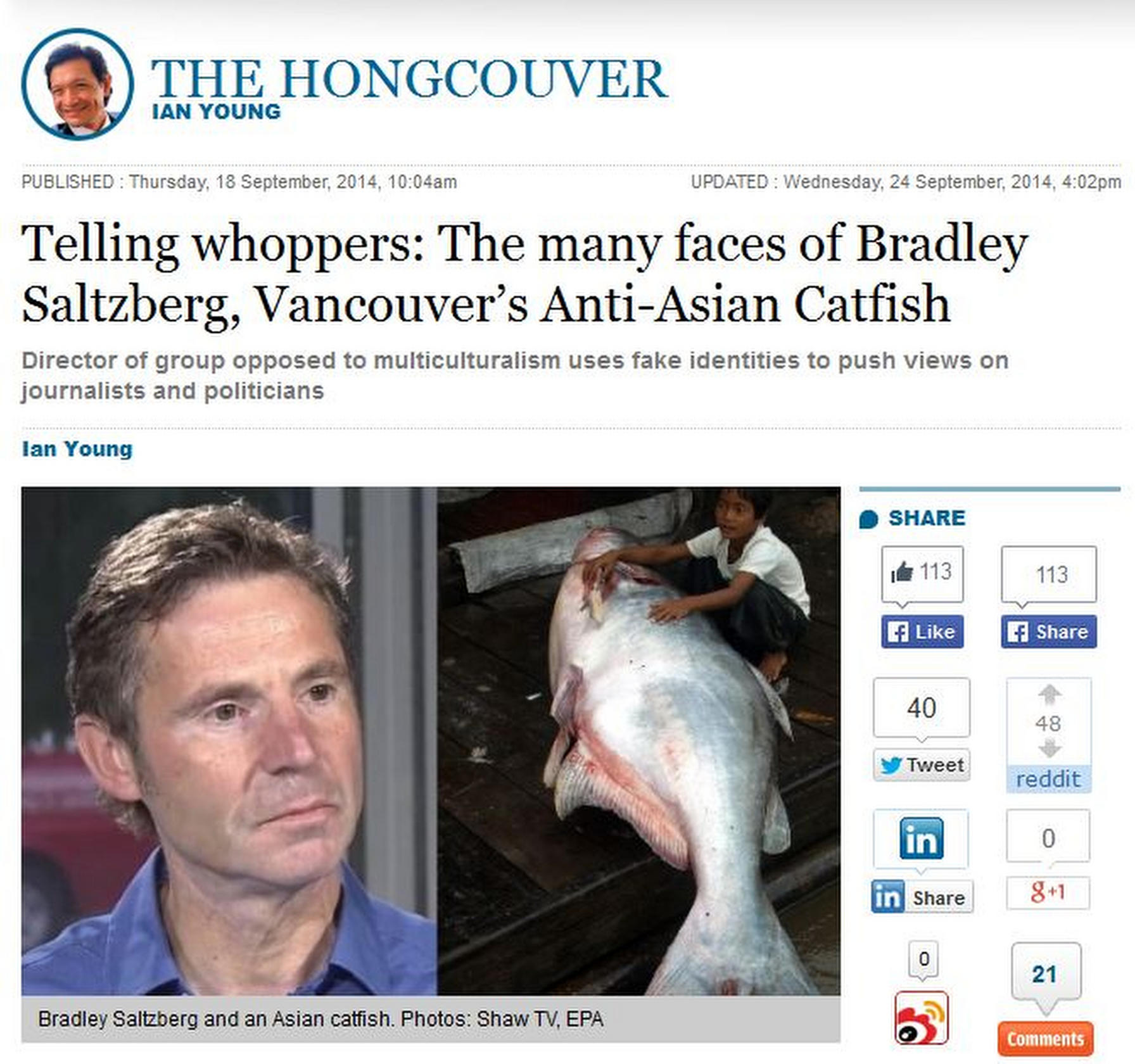
SCMP outed Bradley Saltzberg’s use of aliases to attack Vancouver mayoral hopeful Meena Wong; his own group has now disowned him
PUBLISHED : Monday, 29 September, 2014, 3:23am
UPDATED : Monday, 29 September, 2014, 8:10pm
One of the most vocal critics of Asian immigration in Canada has been fired from the anti-multicultural group he helped found, after the South China Morning Post revealed he had been using fake identities to promote his agenda.
Bradley Saltzberg, one of the directors of Putting Canada First and its British Columbia regional spokesman, was dismissed for having "unnecessarily harmed the organisation through his inappropriate inclusion of race in his discussions, and his use of any unprofessional email techniques", PCF chairman Paul Bentley said, adding that Saltzberg had acted "deceptively".
Saltzberg has recently been targeting Olivia Chow and Meena Wong, two Hong Kong emigrants who are seeking the mayoralties of Toronto and Vancouver respectively. "Voters need to understand the ramifications of these two running Canada's two largest Anglophone cities," wrote Saltzberg in a recent PCF media statement. "Do voters really want two pro-multicultural, ethnocentric candidates running our largest cities? I don't, and from my direct experience, neither do most Canadians of European origin."
However, the South China Morning Post's Hongcouver blog revealed on September 18 that Vancouver-based Saltzberg had also been using two fake identities, "Pascal Brody" and "Paul Bradley", to send emails to dozens of journalists and politicians in support of his views about Wong, without specifically mentioning any connection to Saltzberg or PCF. Brody and Bradley were not merely pseudonymous email addresses; Brody described himself as a "Vancouver community activist" and Bradley responded to email queries in that name, at which point he suggested a journalist contact PCF because he was "not authorised to speak on these issues".
However, both ceased all communications after the Hongcouver blog asked them directly if they were, in fact, Saltzberg. They offered no denial. When asked about this, and confronted with evidence that Brody had been sending photos taken with Saltzberg's smartphone, Saltzberg claimed that both Brody and Bradley were "real people".
He said he knew both men and they supported his views, but was unable to describe their physical appearance. He said he could arrange for the pair to verify their existence via email, but when asked whether they could instead call or meet in person, said "that's probably not going to happen".
PCF posted a brief statement on its website on Friday: "Putting Canada First B.C. Representative Brad Saltzberg will no longer continue with the organisation, and a replacement will be sought shortly."
In an email, PCF chair Bentley said the group had "disassociated itself from Brad Saltzberg in light of his professional misconduct", although he said in a phone interview that he could not definitively state that Saltzberg used fake identities.
"Brad, who had been a member of PCF for several months, had received prior warning from the group regarding his non-compliance with communication protocols, and for undertaking his own interpretation of PCF policies as it relates to public communications. It is most unfortunate that Mr Saltzberg incorporated his personal viewpoints onto PCF," Bentley said by email.
Saltzberg has been by far PCF's most active member, sending hundreds of media statements on the group's behalf. His views have been widely cited by Canadian media.
Despite Bentley's description of Saltzberg as only a member of PCF, "although we did recently permit [him] to speak publicly as our B.C. Representative", Saltzberg is listed in corporate documents as a founding director of the group.
In his email and a subsequent interview on Saturday, Bentley rejected Saltzberg's linking of PCF's agenda to race and apologised. "Our organisation disagrees wholeheartedly with his personal viewpoints in this context, and his approach to act in any way deceptively," Bentley wrote.
"As a relatively new organisation, we are striving to ensure quality control with our members. This can sometimes be challenging, but we are creating safeguards to ensure that incidents like this do not recur," wrote Bentley, who is based in Hamilton, Ontario.
Saltzberg could not be reached for comment on his dismissal. However, in an interview last week, he said: "OK, I got it. No more fake identities, then." He later denied that this amounted to an admission he had employed such tactics.


Anti-multicultural group is pro-Canada, not racist, says chairman
Putting Canada First is a non-profit political organisation that has dedicated itself to challenging Canadian multiculturalism and large-scale immigration. 
Although the ousted British Columbia director of PCF, Brad Saltzberg, had vocally championed the rights of what he called “CEOs”, or Canadians of European Origin, in his media statements for the group, its chairman Paul Bentley said it was not the group’s intention to single out any race.
Bentley said by phone on Saturday that PCF opposed multiculturalism and the current scale of immigration to Canada, although it was not opposed to all immigration. It was not pro or anti any race but was pro-“Canadian culture”, he said. “I would like people to think that we are a very reasonable organisation, and that we are very reasonable people… We’re very Canadian in our approach,” Bentley said.
The group also advocates increased transparency in Canada’s trade negotiations.
He said PCF was primarily involved in conducting research, and that Saltzberg’s widespread media activities had “gotten away from us” and created an “understandable” but false impression that Saltzberg was the group’s primary participant.
Corporations Canada records show that the group was only officially incorporated on March 14 this year, with Saltzberg, Bentley, Dan Murray and Jacob Rivers listed as the founding directors. However, Bentley said the group had been working unofficially for a few years prior to Saltzberg’s involvement, and that its active membership numbered more than 100.
In a letter to Vancouver’s North Shore News in July, Bentley said it was inaccurate to suggest that PCF was invoking a “European Canada”. “We support a ‘Canadian Canada’, and we are not interested in creating European ethnic enclaves in Canada any more than we would support Filipino or Iranian enclaves,” he wrote.
Ian Young in Vancouver

Thursday, October 30, 2014

Film in Presenting the Past


Trailer for Chinese Canadian Stories Project (2010-2012)


All Our Father's Relations (teaser trailer) from Alejandro Yoshizawa on Vimeo.


Gold Mountain River: Exploring History on the Fraser


Gold Mountain River: Exploring History on the Fraser (Chinese version)

Thursday, September 25, 2014

UBC Student Carolyn Nakagawa's Introduction of Dr. Henry Sugiyama at the Asian Canadian and Asian Migration Studies Launch, Sept. 23, 2014


Delivered by UBC Student Carolyn Nakagawa at the Official Ceremony Honouring Dr. Henry Sugiyama as the First Student of the Asian Canadian and Asian Migration Studies Programme at UBC, September 23, 2014

If you’re wondering what my qualifications are for speaking here today (because I had to think about it myself), last year I co-coordinated a student-directed seminar on the Nisei poet and artist Roy Kiyooka, and I’m currently conducting a research project on the life and legacy of Nisei musician Harry Aoki. In 2012, my father, who is here today, was the alumni representative for the honorary degree ceremony for the students of ’42. So there’s been a number of coincidences that have brought me in contact with internment as an experience and a legacy in the two years since my grandmother passed away, that are indirectly connected to her own experience and my grandfather’s of forced relocation during the war.

The history I’ve been learning these past few years is the history of a generation – the wartime Nisei generation, whose experiences form a crisis point for Japanese Canadian history. My grandparents were among them, as were Roy Kiyooka, Harry Aoki, and Dr. Sugiyama. What this generation endured at the hands of the government has become what defines the entire history of the Japanese Canadian community, including how we experience it today. Learning about what happened, I feel like I’m uncovering things that have always been around me, in my own family, that I never properly noticed or understood. My grandparents never spoke about the war, or seemed to want to, to me or to their children. They didn’t seem to think it was important. But the more I read and learn, the more my understanding of my family and myself changes. I’ve realized that the fact that I am here – that I go to UBC and was born in Vancouver and grew up here, natural as it may seem – cannot be taken for granted.

For example, I keep coming across this explanation about Japanese Canadians not having the franchise before 1949, which meant not only that they couldn’t vote, but that they couldn’t be doctors, lawyers, politicians or pharmacists – and that always makes me pause, because my dad is a licensed pharmacist, and the registrar of the College of Pharmacists, which means he actually signs the licenses for all pharmacists in BC, and not only was that not possible for his father because he didn’t economically have access to that kind of education, but even if he had, it wouldn’t have been legal. I think it’s incredible that my grandparents came back to Vancouver after being chased into the interior. I think it’s amazing that, even while they put it behind them and acted like it wasn’t worth talking about, there were others in the community who fought for years until the government gave them compensation. And I’m very proud to belong to a tradition of people as hardworking as my grandparents and as committed to social justice as those who disagreed with them. I’m glad to be a part of welcoming Dr. Sugiyama today because I get to engage with that tradition and not just passively inherit it.


I say I inherit it because I am a fourth-generation Japanese Canadian, and learning about this history I do get the sense that it belongs to me, something I’m able to recognize even if I never knew it before. But I don’t think it’s only my inheritance. It’s the inheritance of everyone who chooses to live or work or study here because “here” is such a fraught and complex term. When I say “here” I mean Vancouver or the Lower Mainland or Canada or UBC in varying contexts; the more I learn about all the places I am in the more I realize that it took a series of atrocities and a series of incredible achievements to bring each and every one of us here. For me I think about the fact that this is Musqueam land, first of all, and my grandparents were forced to leave here in 1942 but they came back and my father was born here and went to UBC. And I am at UBC now, and it was never questioned that I would go here or that I have every right to be here. But that’s not to be taken for granted. Even with that, people look at my face and still don’t believe me when I say I am from here. As much as things seem to change, and do, the past doesn’t disappear. Dr. Sugiyama’s history with UBC may not have stopped him, but it hasn’t disappeared. We here today all inherit that legacy, and what we do with it is the question we’ll be asking in Asian Canadian and Asian Migration Studies.

Keiko Mary Kitagawa speaking about what led to the honouring of Dr. Henry Sugiyama

Dr. Henry Sugiyama sharing his story